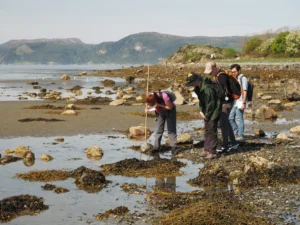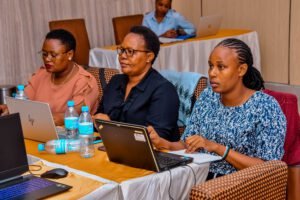
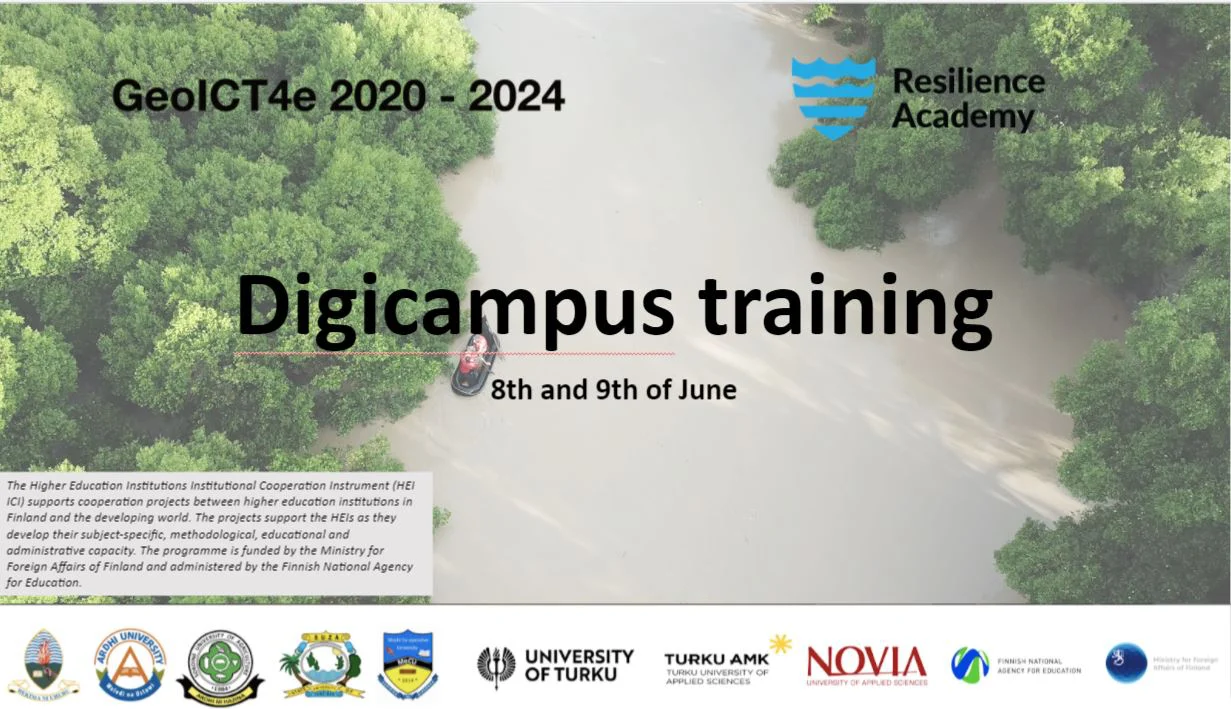
On 8th and 9th June 2021, GeoICT4e and Resilience Academy in collaboration arranged a training to University experts from UDSM, ARU, SUA, SUZA, MoCU, UTU, NOVIA, and TURKU UAS to provide skills on developing e-learning content utilizing Digicampus. The training was targeted to all experts responsible for producing the e-learning materials in the GeoICT4e and Resilience Academy projects.
Digicampus (www.digicampus.fi) is an online learning platform, where you can find common courses for universities, and courses open to everyone, but also universities’ own courses. The university experts who attended the training are expected to use the skills to develop massive open online courses (MOOCs) for the GeoICT4e and Resilience Academy projects, and to be applied in their university curriculums. This way, many university students will be able to access the training materials on various skills for Geospatial and Urban issues to contribute to making cities more resilient.
26 experts participated the training, 22 of the experts working for GeoICT4e. Training was held by E-learning expert Iiris Somervuori, who has experience both in GeoICT4e and Resilience Academy projects. She has already helped teachers in developing e-learning materials to DigiCampus in University of Turku.
“It was excellent to have so many people attending the training. Through discussion, questions and practicals, the two days of the training were very productive. The attendees said they learned a lot about Digicampus and how to make e-learning materials, which was the purpose of the training. Even the experts who have used the platform before got some ideas.
I look forward to seeing all the experts coming up with great e-learning solutions in the future!” says Iiris Somervuori, from University of Turku.
The training was derived from the experiences that Resilience Academy had in preparing the e-learning materials to develop online skills as part of the broader objective to provide skills to University staff and students. GeoICT4e and Resilence Academy are committed to boost openness and accessibility in learning, as well as the development of the digital learning materials, and thus the DigiCampus was chosen as the platform for providing the e-learning materials produced in the projects. It has been tested to work well in Tanzania, too. However, the partner HEIs do have their own platforms in their courses too, and they use the DigiCampus materials as part of the courses and teachers apply the MOOCs or parts of them according to the selected course’s learning criteria.
Training focused on developing online training materials, uploading training materials as well as management of training content. Furthermore, the training provided the participants with a toolkit on how to manage Digicampus platform and, also to show in practice ways to create lectures, quizzes and other activities in the platform. The first day consisted of discussions about e-learning in general, various Digicampus activities and materials. The tools were also given a tryout in practice. The second day consisted of key issues about statistics and the overall managing of the platform and its application in the courses in practice.
Explore the Resilience Academy e-learning material in DigiCampus
Explore the upcoming GeoICTe e-learning materials in DigiCampus
See also Resilience Academy’s news of the DigiCampus Training